
Subject Classes
a comprehensive range of subject classes
These subject classes are an essential part of the Waldorf curriculum for our grades students, not extracurricular offerings. Taught by trained teachers with experience in their subject areas, these classes give students unique opportunities to work with their hands, move, create, and deepen their understanding of the wider world.
“
The need for imagination, a sense of truth, and a feeling of responsibility; these are the very nerve of education.
Rudolf Steiner
Subject Teachers

Early Childhood Eurythmy Teacher

Handwork Teacher

Strings Teacher
Music Teacher

Spanish Teacher

Gardening Teacher

Games Teacher

Upper Grades Math Teacher

Woodworking Teacher

Woodworking Teacher

Handwork
In Waldorf education, handwork is a core academic subject, not
an elective or an “extra”subject because it is designed to integrate
the “Head, Heart, and Hands” of the developing child.
The curriculum teaches children how to transform raw, natural
materials into functional and beautiful objects through a
developmental progression (e.g., knitting in 1st grade, sewing in
8th).
- Core Reasons for Teaching Handwork Brain Development: Fine finger dexterity and rhythmic
movements (like knitting) build brain synapses, enhance
hand-eye coordination, and foster cognitive development. - Academic Foundations: It builds practical connections
to Math (counting, patterning, geometry) and Literacy (eye
tracking, following sequential steps). - Character Building: Projects cannot be rushed, which
teaches patience, perseverance, and the ability to find and
fix mistakes. - Psychological Balance: The repetitive, rhythmic nature of
handwork offers a “breathing” break from intellectual
subjects, helping children develop focus and emotional
regulation. - Sense of Agency: Creating something useful (like a hat or
wooden spoon) gives children a tangible sense of
accomplishment and the confidence that they can change
the world through their own work. - Knitting Stimulates the Brain
Knitting builds the brain by stimulating both hemispheres
– combining mathematics (counting, patterning) with
creativity while engaging the hands purposefully … which leads us to hand-eye coordination. Knitting helps with motor kills, sensory perception and tactile feedback. - Developing focus and delayed gratification
Working through a row of knitting is effective in developing focus. Additionally, the process of coming back to a task day
after day, develops diligence and sense of accomplishment.
Delayed gratification strengthens impulse control and
teaches the benefits of hard work. - A Foundation For Academics
Beyond counting stitches, knitting is mathematically
complicated and relates to different disciplines, from
patterning and geometry to coding. - RELAXATION AND QUIET TIME The rhythmic action of knitting can be similar to meditation, allowing children to relax the mind.
- Self-Esteem: By learning how to knit, children apply their discipline, focus
and coordination to create an item of value and practicality.
They learn that hard work can be rewarded, which builds
their sense of accomplishment. Being able to show that they
made something so complicated all on their own gives them
pride and elevates their self-esteem.
Grades 1 and 2 – Knitting
Knitting trains dexterity in both hands and awakens the child’s mental powers. They see a transformation of a single thread into a two dimensional fabric which can have a three dimensional purpose.
In first and second grade, children develop and improve their fine motor skills and strengthen their abilities in knitting. Knitting improves hand-eye coordination and their ability to focus on a task. As the children begin developing a sense for practical design, they are introduced to color choices and pleasing proportions. Traditionally, sometime in the fall of first grade, eighth graders teach their first grade buddies how to knit. This helps to build relationships between the lower and middle schools. They will learn the ‘knit and purl stitch’ as well as ‘casting on’ stitches. They will also learn to decrease and increase stitches, incorporating math skills in counting, subtracting and adding.
In second grade, working with wool teaches the children’s fingers the feel of natural things. Clear colors allow them to experience the tones and distinguish color families from each other. Projects are introduced and assigned according to a child’s ability. The children create a small animal, usually a cat, at the beginning of the year and then move on to working attentively and excitedly on other gnomes/dolls as they’re learning new stitches and shaping tricks.
Grade 3 – Crochet, Fiber Crafts
The third grade handwork curriculum dovetails the main lesson curriculum in that we bring more active and practical work into the class. The children are learning about farming and structures from around the world in main lesson, so spinning, natural dyeing, and crochet are taught in handwork classes. Most of the year is spent in mastering crochet and making a small project, such as a mat or washcloth and then a hat. Crochet calls upon new finger dexterity and is challenging for the third grader.
The ability to create a round object that moves outward in a balanced rhythm helps ground the children through the nine-year change. This year can be a challenging year for the students as they no longer see themselves as part of a whole, but rather separate and different. In the spring, the children learn to spin using drop spindles. First, they learn how to card wool to prepare it for spinning. Then, the children dye the yarn with natural dyes and then use it in a simple weaving project.
In this year, the students will learn the basic chain stitch and apply the chain stitch in different ways, with more complex combinations of thread manipulations. They will learn to follow a predetermined count of stitches that changes each row in a numerical pattern. They will learn to increase and decrease stitches and judge when to do so, design their own pattern, and learn how yarn is spun from fleece.
Grade 4 – Embroidery
The children start the year with a weaving project using yarn that they dyed last spring. Then, they make a pencil bag. On the cover, the children sew an embroidery sample using different stitches. Finally, they learn the cross stitch. This concept is introduced through a watercolor exercise on folded paper, transferring exact image from one side to the other. The students are asked to draw the pattern on grid paper, creating mirror image designs in two and four directions. Now, they are ready to create a pin cushion or book mark.
The children are being asked to use more precision in their work. The successful completion of the projects, particularly the cross-stitch project, takes care and an ability to see nuances of pattern and balance. In this year, they will complete a weaving project, make a pencil bag, sew an embroidery sample of different stitches, and make a project using cross-stitch.
Grade 5 – Knitting in the Round
Fifth grade brings the students back around to knitting again but at a much more advanced level. They have gone through the nine-year change and are ready for more challenging work. They are in a more harmonious place and are standing with their feet more firmly fixed on the ground.
Periods of easy, rhythmical knitting are interspersed with those more intellectually demanding, like increasing and decreasing, which require them to stay “awake”. It’s a mathematical process that fits their development at this time. This is the last year that knitting is done as part of the regular handwork curriculum and they will make a sock or a hat using a difficult pattern.
The children are being asked to use more precision in their work. The successful completion of the projects, particularly the cross-stitch project, takes care and an ability to see nuances of pattern and balance. In this year, they will complete a weaving project, make a pencil bag, sew an embroidery sample of different stitches, and make a project using cross-stitch.
Grade 6 – Hand Sewing Animals
In sixth grade, the focus is on soft sculpture. This work comes at a time when the students are often experiencing inner turmoil as they approach adolescence. They need something different to keep them interested and engaged in their work. First, the students make curved forms out of clay that evolve into animals. Next, the students select an animal, study it and draw a side view of it. Then, they create a pattern out of the drawing. Later, this pattern is cut out of fabric and sewn together. Accuracy skills are critical when cutting and sewing very small stitches or the pieces of the fabric won’t fit together. They also have to create a gusset (underbody/belly portion) for their animal so that it can be opened and stuffed into a three-dimensional object.
The animal project requires imagination, artistry, craftsmanship and the determination to complete a complex project. The sixth grader often has one leg in and one leg out of childhood and the animal project can offer a sense of comfort in the midst of all this confusion. They will create an animal out of clay, then use this as a model to create a pattern. They will use the pattern to sew the animal, including a gusset.
Grade 7 – Hand Sewing
In seventh grade, the focus is doll making. At our school, the students are introduced to puppetry. By preparing a story for younger children, the seventh graders partake in community service. This work allows the seventh grader to develop a better awareness of his actions and words on others. In preparation for this work, a puppeteer comes and introduces the seventh grade class to string marionettes. The choice of the story is made with Early Childhood in mind. Each student makes a character from the story, which means creating a body complete with head, hair, legs and arms. Once the base of the puppet is complete, final touches create the real character. The hands are the last step for the final stringing.
The seventh graders give such joy to the younger children through their production; they see how much their work penetrates the young child. This project encourages seventh graders to be good role models for younger children, to be upright and responsible young adults.
Grade 8 – Machine Sewing
In eighth grade, the students build on what they have learned so far and turn to machine sewing. This coincides with their study of the Industrial Revolution in main lesson. By the end of eighth grade, the students have a good grounding in textile arts but more importantly, they have learned perseverance, an appreciation of beauty and a sense of satisfaction that comes from accomplishment.
Spanish
Spanish is taught in Waldorf schools starting in the early
grades to foster cultural empathy, enhance cognitive
development, and cultivate a global perspective. Using
immersive, artistic, and oral-based methods, the curriculum
connects students to new ways of thinking, boosts neural pathway
development, and develops compassion by introducing different
worldviews rooted in language.
Key reasons for teaching Spanish in Waldorf education include:
- Development of Empathy and Social
Conscience: Learning another language helps children
move beyond their own perspective, fostering a sense of
connection to different cultures and promoting empathy,
which aligns with Waldorf's goal of raising compassionate
human beings. - Cognitive and Linguistic Benefits: Introducing languages
early (often in Grade 1) capitalizes on a child’s natural
capacity for imitation, enhancing brain development,
memory, and cognitive flexibility. - Immersive and Artistic Approach: Spanish is taught
through songs, poems, games, and stories rather than
formal grammar, allowing children to absorb the language
naturally treating it as an experience to be felt rather than a
subject to be analyzed. - Cultural Connection: Spanish is a widely spoken global
language, providing students with access to diverse cultures
and preparing them to be global citizens. - Balanced Education: According to Rudolf Steiner, learning
multiple languages balances a child's development, with different languages impacting the “will” and “imagination” in
unique ways.
Grades 1 - 3
In first through third grade, lessons are brought through imitation, gestures, storytelling, songs, poems, puppetry and movement. Children also learn vocabulary, like colors, parts of the body, animals, days of the week and numbers to name a few. In addition, children are able to follow commands, recite verses, sing Spanish songs and answer basic questions. By learning this way, students feel inspired and value another language.
In these early years, the students are learning the sounds of another language and able to understand basic repetitive questions and sentences. By second and third grade, they will learn to answer questions in complete sentences, learn songs and poems by heart, and follow simple directions in Spanish. They will also learn basic vocabulary, like parts of the body, colors, numbers, food, animals, seasons, basic shapes, and opposites in first grade. This will continue with days of the week, months, items of clothing, common names of family members, and the position of objects in second grade. In third grade, they will continue to review and expand on old vocabulary and learn new words, like parts of the house and occupations in third grade. They will listen to simple books: Oso Café, Oso Polar in first grade, La Oruga Tiena Hambre and La Araña Muy Ocupada in second grade and Donde Duermen los Animales, La Gallinita Roja and La Viejita Que No Tiene Miedo a Nada in third grade. By third grade, students will learn to tell time, perform plays and skits, and learn about the cost of items in Spanish.
Grade 4
In fourth grade, students learn how to read and write in Spanish. Grammar is also formally introduced. A variety of activities are used to create descriptive sentences. They will memorize, recite or perform poems and songs. The students learn the agreement of gender, pronouns and a number of nouns with adjectives and articles. Students learn the alphabet in Spanish and begin to write in Spanish.
Grade 5
In fifth grade, students memorize many verbs, both regular and irregular, and learn to conjugate them in the present tense, such as ir, ser, estar, and tener.. They will review and learn new vocabulary, like classroom objects, places around the city, and verbs, especially the meaning of new verbs. They are able to retell stories and answer questions in complete sentences. Spelling is a focus of their written work. They will learn personal pronouns, placement of adjectives, gender and number of nouns in agreement with articles, and present tense for regular verbs. They will learn about countries that speak Spanish.
Grade 6
In sixth grade, the verbs, ser and estar, are studied in depth. The students continue to master spelling and pronunciation. They become quite capable of retelling stories, answering questions in complete sentences and learning the capitals of Spanish speaking countries. Of course, vocabulary is constantly being expanded. They will learn more irregular verbs, like querer, poder, pensar, and gustar.
Grades 7 - 8
In seventh and eighth grade, other tenses besides present tense are studied. The students learn perfect, imperfect and future tenses. More tenses are included if the class is ready for them. In addition, more irregular verbs are introduced. Important Hispanic landmarks and famous Spanish speaking people are studied. The students make oral presentations and take tests on a regular basis in order to memorize the grammatical structure of more complex sentences and they read and retell stories. Students are expected to understand and respond to new questions by applying grammar and vocabulary studied and to understand the majority of the lesson, which is conducted in Spanish, primarily. They will learn new vocabulary, reflexive verbs, more regular and irregular verbs, direct and indirect object pronouns. Their grammar will develop further, like present, preterit, future and present progressive verbs. The teacher may introduce past and present perfect, present subjunctive, commands, conditional and imperfect in eighth grade. Students will complete a project about a Latin American or Spanish landmark in seventh grade. By eighth grade, complete a project about an important Hispanic artist, writer, or politician.
Games & Movement
In Waldorf education, teaching movement is fundamental to child
development, acting as an integral part of the learning process
that links physical activity with cognitive, emotional, and social
growth. It engages the whole child, improving memory, focus, and
academic understanding while fostering a deeper connection to
themselves and their environment.
Key Aspects of Movement in Waldorf:
- Integrated Learning: Movement is woven into academic
subjects, using games, drama, and artistic activities to teach
concepts like math, language, and science. - Holistic Development: It addresses body, mind, and spirit,
promoting healthy physical development while supporting
emotional resilience and creativity. - Cognitive Benefits: Studies, such as those from Harvard
Medical School, indicate that movement stimulates brain
development, enhancing memory and, ultimately, academic
performance. - Foundational Skills: In early childhood, movement builds
the foundation for spatial awareness, coordination, and
confidence.
By prioritizing movement, Waldorf education ensures children
develop not just academically, but also socially and emotionally,
fostering well-rounded individuals.
Grades 1 - 8
In first and second grade, the students live in the world of imagination and imitation. Games are presented in the form of a story and the students transform themselves into animals, princes, or thieves. Games like “Bunnies and Burrows”, “Scarecrow Tag” and “Giants, Wizards, and Elves” are played. Class begins with a formal greeting to the students. The first activity usually involves movement as a group in the spirit of helping the class teacher form the class. Then, a story is told and a game is played. Throughout the year, the children take time to enjoy the seasons and beautiful surroundings by going on walks to the duck pond and park, jumping in leaf piles, or digging on the dirt hill.
In third and fourth grade, the students continue playing the games they’ve learned in first and second grade as well as learning new games and activities, keeping in mind the curriculum and child development. Circle games, in the early grades, give way to games with two groups facing each other or one student leaving the circle. Students experiencing the nine year change get to experience both being a part of the group and stepping out of the group. The fourth grade plays games like “Fire and Ice” where the children live into Norse mythology which has been introduced during main lesson. For third through sixth grade, the Games instructor ties the activities in with the curriculum – seasons, elements, and human development – as much as possible.
Fifth grade is a magical year in Games class at our school. The students spend most of the year in training for the Greek Pentathlon. They learn how to throw the javelin and discus, compete in running and jumping events, and learn a modified form of wrestling. At the end of the year, they join other fifth grade classes at Live Oak Waldorf School for an all-day event in the style of the Greek games.
After the Pentathlon, the sixth graders are introduced to team sports and, more importantly, how to be part of a team. The Games instructor and students spend a lot of time doing trust and team-building exercises. They also learn how to stretch and do calisthenics in a safe, healthy way. In the spring, the sixth graders train for the Medieval Games where they are expected to shoot a bow and arrow, climb over a wall, play tug-of-war, or hit a target with a javelin. The students also learn juggling and do basic tumbling.
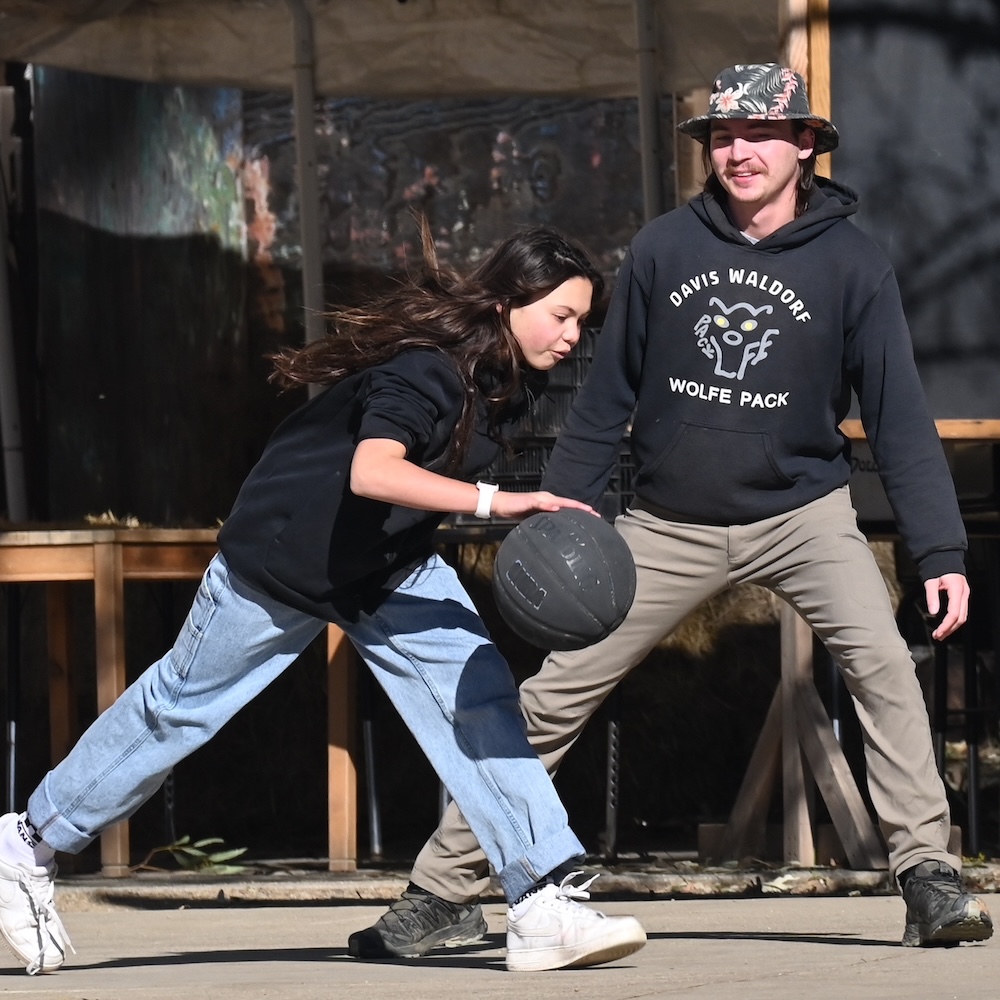
In seventh and eighth grade, the students continue to learn about team sports with an emphasis on teamwork, etiquette, sportsmanship, and fundamentals. We play soccer, basketball, football, kickball, ultimate Frisbee, dodgeball and capture the flag. In addition to team building activities, the middle school students also learn basic self-defense, play art and acting games, and train for the eighth grade track meet, which includes events like running, discus, javelin and long jump.
[1] Payne, Kim John. Simplicity Parenting: Using the Extraordinary Power of Less to Raise Calmer, Happier, and More Secure Kids. New York: Ballantine, 2009. Pg. 158.
In these early years, the students are learning the sounds of another language and able to understand basic repetitive questions and sentences. By second and third grade, they will learn to answer questions in complete sentences, learn songs and poems by heart, and follow simple directions in Spanish. They will also learn basic vocabulary, like parts of the body, colors, numbers, food, animals, seasons, basic shapes, and opposites in first grade. This will continue with days of the week, months, items of clothing, common names of family members, and the position of objects in second grade. In third grade, they will continue to review and expand on old vocabulary and learn new words, like parts of the house and occupations in third grade. They will listen to simple books: Oso Café, Oso Polar in first grade, La Oruga Tiena Hambre and La Araña Muy Ocupada in second grade and Donde Duermen los Animales, La Gallinita Roja and La Viejita Que No Tiene Miedo a Nada in third grade. By third grade, students will learn to tell time, perform plays and skits, and learn about the cost of items in Spanish.
Gardening
Gardening is central to Waldorf education to foster a deep,
hands-on connection with nature, teaching stewardship,
patience, and responsibility. Integrated from the first
school in 1923, it serves as an outdoor classroom
strengthening physical, academic, and emotional
development—head, heart, and hands—throughout the
school years.
Key reasons for gardening in Waldorf schools include:
- Connection to Nature and Seasons: Students learn
to understand the natural world, its cycles, and their
role as caretakers of the earth. - Holistic Learning ("Head, Heart, and
Hands"): Gardening is integrated into academic
studies (math, science, botany) and involves practical,
physical work that builds dexterity and confidence. - Child Development: It supports emotional and
physical health, providing a calming, therapeutic
experience away from technology, fostering
teamwork, and building resilience. - Practical Skills and Nutrition: Students gain, direct
experience in planting, tending, harvesting, and
preparing food, which fosters an appreciation for
healthy eating. - Developmental Appropriateness: In, early years it
is about nurturing, while in the, middle years it
connects to farming, botany, and, environmental
studies.
Grade 2
Second graders begin caring for the earth and all of her creatures with greater love and attention. Gardening is structured to promote cooperative work and a spirit of joy as children care for the garden, the creatures, and the school community. Children hone their observation skills while they explore the garden.
Grade 3
Farming is a major area of study for third graders. They learn about animals on a farm, planting in relation to the seasons, and composting. There are several practical tasks for children to do, like clearing weeds or turning the compost pile. Students enjoy following the lifecycle of a seed to a plant and harvesting seeds to be passed on to the next third grade class. The children plant many grains, like wheat or barley, which are mentioned in the Old Testament. They also learn about plants used for dyeing, like indigo or Osage orange. They begin to construct simple gardening tools and structures as they learn about shelters from around the world during main lesson. All the tending to the garden provides a bounteous supply of fruit and vegetables that are used during a weekly cooking class.
Grade 4
Fourth graders learn about native plants used by the Indians. Many of these plants can be found on campus or by taking a short walk to the Greenbelt. Students make many maps, like imagining what the campus might have looked like before settlers came. The children study the importance of animals and insects to the garden and treat them with kindness and respect. They learn how to cultivate and care for red wiggler worms and how to use their castings in the garden. The students also create habitats for birds, bats and beneficial insects. All this work teaches the children about the interdependence of all plants and creatures.
Grade 5
In fifth grade, students are introduced to botany. They learn about the ten vegetable families and broaden out to fungi and tree communities. Students also explore the uses of herbs, both medicinal and culinary, through various gardening projects. Finally, students learn how to make objective observations of plants and insects in the garden and natural world, following the Goethean principles.
Strings
Our strings program begins in the fourth grade with our dedicated Strings teacher, when students learn to play the violin, viola, or cello.
The strings class teaching style combines two common methods of strings instruction – ear training and note reading. Ear training, the approach used in the Suzuki method, develops a good sense of intonation, while note reading ability allows the students to rehearse effectively together in an ensemble. These skills are developed further in the fifth grade strings class. Students in sixth through eighth grade who wish to continue playing a stringed instrument rehearse as strings ensembles. Currently, the sixth grade strings players are in a separate class and the seventh and eighth grade strings players are combined into one class. Ensemble repertoire incorporates a variety of musical styles including renaissance, baroque, classical, and romantic chamber music. We also enjoy playing movie tunes and holiday music. All strings classes meet twice per week. Sixth through eighth grade strings classes include music theory instruction that focuses on utilizing key signatures in the keys of C, G, D, A, F and B-flat major as well as the construction of major and minor scales. Students are expected to practice at home in the following way: fourth grade for twenty minutes, four times a week, fifth grade for twenty minutes, five times a week, and sixth through eighth grade thirty minutes, five times a week.
Strings classes typically perform at the Winter Assembly and the Strings Concert in the spring. Additional performance opportunities have included community service concerts at nursing and retirement homes.
It has been very beneficial for students to have some ear training (such as Suzuki lessons) in private lessons during third grade or earlier. Private lessons are always recommended but not required, as most students need individualized support.
Fiddling is a popular after-school volunteer activity for many students. On most Fridays, a fiddle class elective is offered that is open to all strings students who are willing to practice extra hours to learn the fiddle music. In recent years, Davis Waldorf Fiddlers have performed at our school events, such as May Faire, the Benefit Dinner, Grandparent’s Day and Open House. They have also performed in the wider community at the California State Fair, the Hoes Down Festival, the Davis Farmers’ Market, the Woodland Stroll Through History, St. John’s Retirement Village, University Retirement Community, Covell Gardens, the Gibson House Fall Festival, Woodland Presbyterian Church, the Woodland Rose Club Garden Tour, live on KDRT radio and on Davis Community Television, the International House, the Davis Senior Center and various other sites. In the 2008-2009 school year, an especially busy year, Davis Waldorf School strings players participated in over fifty performances at school or in the community.
Woodworking
Woodwork in Waldorf education is a vital, hands-on activity
that fosters holistic development by connecting the head, heart,
and hands, starting typically around Class IV. Using natural
materials and hand tools, students build fine motor skills,
confidence, patience, and perseverance while creating functional
items, enhancing their connection to nature and fostering
sustainable values.
Key benefits and aspects of teaching woodwork in Waldorf
include:
- Physical & Cognitive Development: Enhances hand-eye
coordination, dexterity, and fine motor skills through precise,
manual work. It also strengthens spatial awareness and
mathematical concepts like measurement and engineering. - Social & Emotional Growth: Completing projects builds
self-esteem, confidence, and a sense of "can-do" agency. It
fosters patience, perseverance, and focus, teaching that
quality takes time and effort. - Practical & Artistic Skill: Students learn to use, respect,
and maintain hand tools (saws, chisels, drills) safely. They
transform raw, natural materials into useful objects like
spoons, bowls, and tools, bridging the gap between artistic
vision and functional utility. - Connection to Nature & Sustainability: By working with
wood, children develop a deep appreciation for natural
materials and a sense of gratitude for the earth's resources,
countering modern consumerism. - Developmental Appropriateness: Starting with simple
tasks like whittling in 5th grade, the curriculum progresses
through the middle school years to more complex, physically
demanding projects that align with adolescent development.
Grades 5
In fifth grade, students are introduced to the nature of wood and the many ways that it contributes to human living. Students learn to guide the transformation of raw wood into items of usefulness and beauty using simple yet effective tools. The school year begins with the shaping of a butter knife out of locally-obtained sycamore wood using a coping saw, rasps, and sand paper. The knife is completed by Winter break, and it glows with a final coating of olive oil and beeswax. Next, students take on the more challenging project of carving a mouse out of birch or sycamore branch wood. With a carving knife in hand, the students gain a more direct and organic connection to the wood compared to the sawing and rasping already learned. In the end, the mouse is adorned with ears, eyes and tail, which has a delightful animating effect on their wooden creation. The use of short projects to keep students engaged, while others are completing larger projects, add variety and interest. Other short projects make use of local branch wood to craft buttons and carve wall hooks. An introduction to gouges and relief carving may also be introduced at the end of fifth grade.
Grades 6
In sixth grade, students continue with carving which consists of the insightful removal of wood until the desired form is achieved. They begin the year by making a simple mallet. This project gives them the experience of crafting a tool that they then put to use in the making of a spoon. The spoon, so familiar yet also complex in form, challenges their growing capabilities and leaves them with something that is both pleasing and practical. To create the spoon, students begin with branch wood and learn to use an axe to rough out the basic form of the spoon. The use of the gouge and mallet is introduced next, and the spoon is completed using carving and other shaping methods.
Grades 7
Seventh grade marks a shift to woodworking that requires measuring and constructing but still offers creative expression and practical application. In addition, an attempt is made to complement some aspect of the classroom curriculum. To achieve these goals, a tortilla press is made as it illustrates the physics presented in the classroom, and is very useful at home. The press has a lever and fulcrum, and is hinged. Students learn to measure and saw accurately by hand, use a draw knife and shaving horse, and are challenged to drill with accuracy. The press also contains a wood joint which must be sound and sturdy. The press is made from a combination of purchased dimensional hardwood and local urban branch wood of the students’ choice. Following completion of this project and as time permits, students craft items that are useful to the school. They may make bat houses, benches, picnic tables, signs, and improvements to the wood shop, etc. These types of projects are typically small, group-based projects to foster a cooperative spirit and practice.
Grades 8
The eighth grade feels like a year of looking back at the grades past, and also looking ahead to a new school environment and new challenges. In the woodworking curriculum, students make a personal piece of furniture to mark this time – a three-legged stool upon which they can sit to view the world from their vantage point! This project engages the students in several important ways: It is physically demanding, it requires attention to design and construction detail to create structural soundness and beauty, and it provides plenty of room for creative expression. The round mortise and tenon are introduced, wedges are made to secure joints, and the plane is also used. By the eighth grade year, there is a lively readiness to take on this project, with students applying themselves with great vigor, yet great care. A variety of woods are obtained from local sources, and students select their own pieces and shape them with their individual creativity. Students completing the stool project with time remaining either assist other students or work on an additional small project. As in seventh grade, the additional project is generally designed to contribute something to the school.
Middle School Math
Waldorf education teaches mathematics as an experiential,
artistic, and developmental process, focusing on fostering deep conceptual understanding, resilience, and a love for learning
rather than mere memorization. By integrating movement, rhythm,
stories, and practical application, math becomes a creative, multi-
sensory experience that engages the whole child, building strong
foundational number sense.
Key aspects of teaching math in Waldorf include:
- Experiential Learning: Concepts are introduced through
movement (clapping, jumping), story, and art, such as form
drawing and geometric patterns. - Developmental Approach: The curriculum follows the
child’s development, starting with concrete, hands-on
activities in early grades (using manipulatives) and moving
toward abstract concepts like algebra and calculus in high
school. - Interdisciplinary Integration: Math is linked to daily life,
music, history, and science, helping students see the
relevance and beauty in numbers. - Building Resilience : Students learn to view mistakes as
learning opportunities, fostering a, resilient approach to
problem-solving. - Mental Math & Creativity: Frequent practice of mental math
enhances computational skills and mental flexibility.
This approach, rooted in Anthroposophy, aims to nurture thinking
skills that extend beyond the classroom, turning mathematical
concepts into a “creative, open space.”
Grades 6
In sixth grade, the intent is to inspire curiosity while exploring the beauty and complexity of mathematics in an age appropriate way. Many skills are integrated into the years’ curriculum, which meets the sixth grader developmentally, as they are ready for new and exciting, yet structured and clear academic experiences. Skills include constructing and graphing on a number line, solving word problems, measurement and conversion, working with decimals, fractions and percents, the order of operations, and continuous building and usage of mathematical vocabulary. In addition to mathematics, students gain skills in time management and study habits, and are encouraged to communicate with their new teacher in a productive, helpful, and more autonomous manner than ever before. Various projects, activities, and opportunities to artistically work with mathematics are included through each block and the year.
Grades 7
In seventh grade, students are developmentally ready for more challenge and exploration, and are ready to stretch their thinking into new realms. Our math curriculum includes the exploration of the untidy, wondrous and more abstract aspects of mathematics, such as exponential notation, irrational numbers, integers, graphed inequalities, and much more. The study of geometric concepts is included throughout seventh grade, which includes working with formulas, the Pythagorean theorem, and more complex work in areas, perimeters, and angles. As well, formal algebraic concepts are introduced in seventh grade in preparation for our eighth grade curriculum. Artistic and hands-on activities are included in each block, and students are expected to build upon their communication and time management skills they began to develop in sixth grade.
Grades 8
In eighth grade, students are ready to deeply explore and gain an understanding of the vast world of algebra, and dive more into the abstract concepts of geometry. Introduced with an emphasis on providing opportunities for the students to build mental images relating to the concepts, the curriculum includes the study of linear relationships, ratio and proportion, number bases, exponents and polynomials, radical expressions, and much more. Students are asked to work individually and with groups, and are continuously asked to connect their study in mathematics to real-world applications and situations. Students not only gain skills, but also continue to develop an appreciation for the structure, complexity and internet beauty of mathematics. Artistic and hands-on activities are woven into the years’ curriculum, and students are encouraged to take up their mathematics education with all the more enthusiasm and self-direction, so they are all the more prepared to enter into their future educational journey upon graduation from Davis Waldorf School.